The Hub Before the Howl: A 2026 UK Wheel-Bearing Fitment Check That Beats a Second Strip-Down
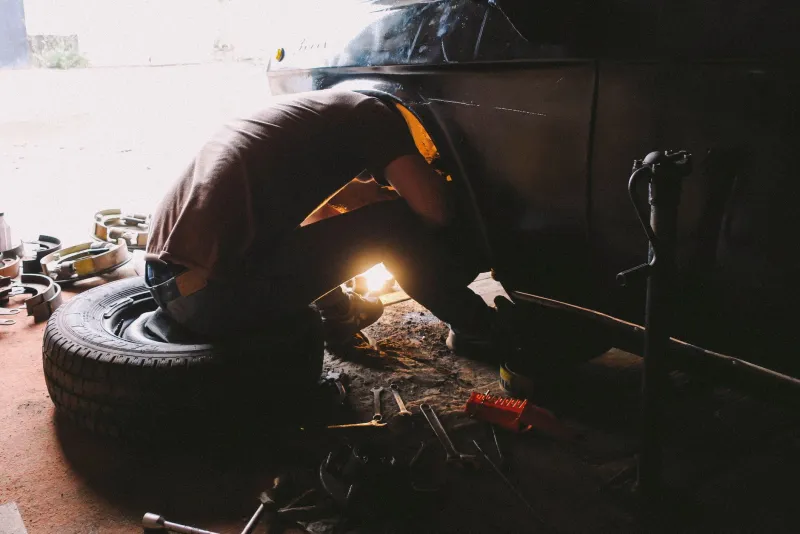
November in the UK is pothole season with a side order of salt. That grumble from the front corner is often a wheel bearing, but it can just as easily be a cupped tyre, a noisy brake disc or an ABS encoder ring that's given up. The expensive mistake isn't usually the diagnosis — it's ordering a hub assembly that fits the hole but not the car. Get the encoder type, flange, sensor arrangement or axle-nut spec wrong and you'll be stripping the same corner twice, with an ABS light as your reward.
First, prove it's the bearing — not the tyre
Before you open a parts catalogue, do the cheap checks. Road noise is a poor witness: tyres can mimic a bearing hum, especially with uneven wear from pothole damage or a lazy alignment. Find a quiet stretch and weave gently at moderate speed. A wheel bearing usually changes note as load shifts — turning left loads the right-hand bearing, and vice versa. A tyre tends to keep the same drone.
Next, get the corner safely in the air and check for play at 12-and-6 o'clock and 3-and-9 o'clock. Compare both sides. A tiny amount of movement can be normal on some setups, so don't condemn a bearing on play alone. After a short drive, carefully compare hub temperatures side to side — a dragging bearing or brake will often run hotter. And if you have a scan tool, watch live wheel-speed data at walking pace on a straight road. A signal that drops out or jumps while its opposite number stays smooth points at the sensor or encoder, not necessarily the bearing.
The fitment traps that trigger the ABS light
Encoder type is the big one
Many modern hubs carry the ABS encoder in the bearing seal as a magnetic ring. Others use a toothed reluctor ring or a different sensor design. Two hubs can look identical on the bench and still give you a dashboard warning because the encoder inside doesn't match the sensor on the car. Registration lookups are a starting point, but they are not a guarantee on facelift, trim or brake-package changes.
Sensor included — or sensor extra?
Some complete hubs arrive with the ABS sensor and its mounting bolt; others expect you to reuse the old one. If the old sensor is seized, corroded or has been disturbed, reusing it is a false economy. Check what's in the box before you pay, and price the sensor separately if needed.
Flange diameter, offset and brake clearance
Hub flange diameter and offset affect how the brake disc sits and whether the caliper clears. A hub from a different brake package — say, a larger front disc setup on a higher trim — may bolt up but sit wrong. Check the disc retaining screw, the disc location spigot and the caliper bracket clearance before the wheels go back on.
PCD, studs and spigot
Bolt pattern and pitch matter, but so does whether the hub uses studs or bolts and what the centre spigot diameter is. This is where cheap aftermarket hubs often fall down: the headline fitment looks right, but the wheel doesn't sit square.
Press-fit bearing or complete assembly
If the bearing is pressed into the knuckle, you need a press and the right adapters — not a hammer and a socket. For most driveway mechanics, a complete hub assembly is the pragmatic buy. It costs more, but it removes the press work and the risk of damaging a new bearing during installation.
The ordering checks that stop the second strip-down
Start with the registration, then confirm with the VIN. The reg gets you into the right ballpark; the VIN narrows the build, axle and brake package. Check the VIN plate, door jamb or windscreen and match it to the listing. If the seller only asks for a reg, ask a follow-up question.
Compare the old part number against the new one and note any supersession. Don't assume a later number is wrong — manufacturers revise parts — but do confirm it supersedes in the right direction. Check whether the hub is handed, whether it includes the bearing, sensor and fixing hardware, and whether the axle nut is included. Many axle nuts are torque-to-yield and should be replaced, not reused.
Torque specs are not guesswork. Use the manufacturer's figure for the axle nut and tighten it correctly — often with the vehicle on the ground and the brakes applied, depending on the design. A rattle gun on final torque is how you preload a bearing wrong or stretch a nut. Clean the mating faces, fit a new nut where specified, and don't forget the ABS sensor bolt and brake disc retaining screw.
A quick pre-order checklist
- Registration and VIN both checked
- Axle side confirmed — left or right, front or rear
- ABS encoder type matched to the car
- Sensor included or separately priced
- Flange diameter, offset and brake clearance confirmed
- PCD, stud/bolt arrangement and spigot diameter checked
- Complete hub or press-fit bearing decided
- Axle nut and any one-shot hardware in the basket
- Torque figure and tightening procedure to hand
None of this is glamorous, but it's cheaper than doing the job twice. Buy the hub that matches the car, not the one that matches the photo, and you'll keep the ABS light off and the second strip-down for someone else's driveway.