Hose Maths, Not Guesswork: Sizing Coolant and Boost Pipes Before They Bite
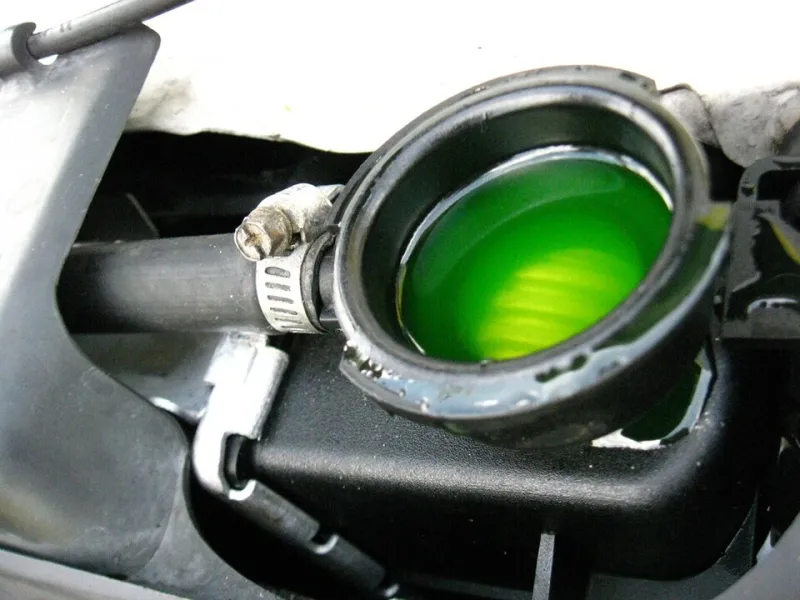
Photo: EvelynGiggles, CC BY 2.0, via Wikimedia Commons
A coolant leak rarely starts with drama. More often it begins as a chalky stain near a clip, a faint sweet smell after a run, or a header tank that needs a top-up every couple of weeks. By the time the cold snaps arrive and the thermostat is cycling hard, that small weep can become an overheating episode and a very expensive head-gasket conversation. The answer is not to grab the thickest-looking hose on the shelf. It is to do the hose maths first: inside diameter, clip style, moulded shape, material and pressure rating, then cross-check the OEM number before you pay.
Start with the inside diameter, not the outside
Hose listings are brilliant at quoting the wrong dimension. A hose advertised as 38mm may be 38mm outside diameter, while the stub it needs to seal onto is 32mm inside diameter. Those numbers are not interchangeable. Measure the clean section of the old hose with a caliper, away from the swollen end, and measure the metal or plastic stub as well. For boost hoses, check both ends: compressor outlet, intercooler inlet and throttle body can all differ, and some pipes are stepped or tapered.
A swollen hose lies to you. If it has gone soft and ballooned, the original diameter is buried somewhere in the middle. Use the stub as the reference, or check a parts diagram. On modern engines, a half-millimetre matters. A hose that is too large will tighten down and pucker; one that is too small will fight you onto the stub and never sit properly under the clip.
Clips are part of the joint, not an afterthought
OEM spring clips look flimsy, but they are designed to keep tension as the engine heats and cools. A cheap worm-drive clip can bite unevenly, cut into the hose and create a leak path exactly where you do not want one. If the original is a constant-tension spring clip, replace it with the same type and size. If it is a worm-drive from the factory, match the band width and avoid over-tightening. For boost hoses, T-bolt clamps are common for a reason, but they still need the correct diameter and a smooth mating surface.
Do not recycle tired clips. A clip that has been sitting in coolant crud for eight years has done its shift. Buy the correct clip with the hose, not from a mixed tub of unknowns. And check the clip sits on the bead, not behind it or half on the hose shoulder.
The moulded shape is doing a job
Modern engine bays are packed. A moulded hose routes around the alternator, clears the EGR cooler, dodges the air-con pipe and keeps away from exhaust heat. A universal straight hose with a bend shoved into it may look fine on the driveway, but it can rub through on a bracket or collapse under vacuum. Check locating tabs, heat sleeves and retaining clips. Compare the new hose with the old one before fitting, and if the old one is so swollen that the shape is distorted, use an OEM diagram or a photo of the engine bay to confirm the route.
Boost hoses are worse for this. Some have internal ribs or a specific bore to stop them ballooning under pressure. A generic silicone elbow may fit the ends and still oil-can, rub or blow off under load. If the original has a sensor boss, a mounting lug or a specific bend radius, buy the part that matches it.
Pressure rating and material specs matter
Coolant hoses are usually EPDM with reinforcement. Boost hoses need a burst rating and temperature range that suit positive pressure and heat. Do not accept “high performance” as a specification. Look for the material, reinforcement and pressure rating, and check that the hose is suitable for coolant rather than just air or water. Silicone is not automatically better for every job; some grades are excellent for boost, but the wrong liner can be a poor match for coolant or oil mist.
Universal hose is a get-you-home item, not a long-term repair. It can work in an emergency if you keep it away from heat and abrasion, but on a modern engine with tight routing and plastic stubs it is often false economy. The correct moulded hose costs more than a metre of generic rubber; it costs a lot less than a head gasket.
Cross-check the OEM number like you mean it
Use the registration to narrow the search, then confirm with the engine code, model year and OEM number from the old hose or a parts diagram. Supersessions happen, and aftermarket listings often bundle several numbers together. Check that the listing matches your engine, not just the model. For boost hoses, confirm sensor bosses and mounting points. If the number has changed, verify the replacement is the current supersession rather than an old stock item for a different build.
The driveway inspection that pays for itself
Do this with the engine cold. Shine a torch along every coolant hose, especially under the clips and at the ends. Look for swelling, soft spots, cracks, white crust, rusty stains or a damp sheen. Squeeze the hose gently; it should feel firm, not spongy. Check boost hoses for oil mist and loose clips. Then run the engine up to temperature and watch for steam or drips. Do not open the expansion cap when hot.
If a hose looks tired, change it before winter. A coolant leak that weeps onto a hot manifold smells awful and can hide until the temperature gauge climbs. The hose is the cheap part. The head gasket is the bill you are trying to avoid.