Knock First, Buy Second: Tracing Front-End Noises Before the Suspension Bill
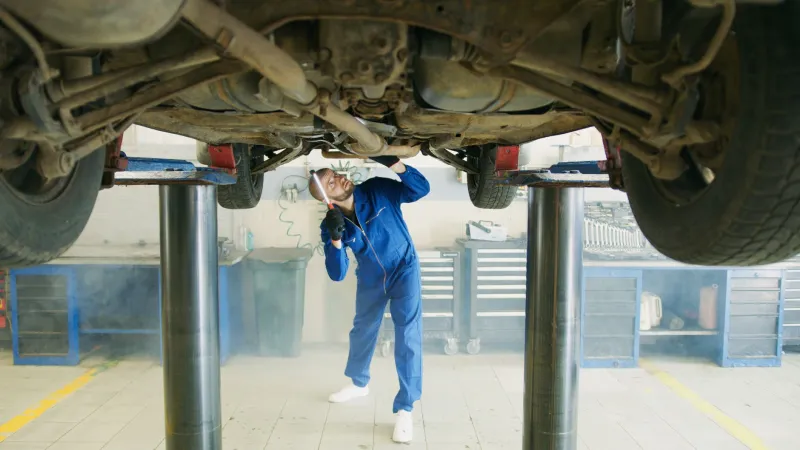
Front-end noises are brilliant at making UK drivers buy the wrong part. You hear a clunk over a speed cushion, ring the motor factor, and somehow a pair of complete struts ends up on the counter. Nine times out of ten the culprit is smaller, cheaper and hiding behind the wheel arch. The trick is to treat the noise like a symptom, not a shopping list.
Reproduce the Noise Before You Reach for the Jack
A suspension knock that only appears on one broken stretch of B-road is hard to diagnose. Find a quiet car park or a empty industrial estate and recreate the conditions deliberately. Note the speed, whether you were braking, steering or just rolling, and whether the noise came from the nearside or offside. Record it on your phone if you can. Cold mornings often sharpen tired rubber bushes, so a noise that disappears after ten minutes is telling you something.
Do not start unbolting parts to find a knock. A loose drop link can feel tight when the suspension is hanging at full droop. Check what you can with the car sitting on its wheels first, then move to a ramp or axle stands with the suspension loaded.
The Timing Test: When It Knocks Matters More Than How Loud
Use the conditions as your first filter. The same clunk can come from three different components, but the moment it happens usually narrows the field.
| What you hear | When it happens | First suspect | Quick driveway check |
|---|---|---|---|
| Light, rapid rattle | Ripples, rough tarmac, low speed | Drop link ball joints, brake pad springs, loose arch liner | Rock the anti-roll bar link by hand with the car on the ground |
| Heavy single clunk | Speed humps, potholes, uneven junctions | Anti-roll bar bushes, lower arm bush, drop link | Look for cracked rubber and shiny metal contact marks |
| One knock when turning | Stationary or parking-speed steering | Top mount bearing, spring seat | Assistant turns the wheel while you watch and listen at the strut top |
| Clunk under braking over bumps | Braking and uneven surface | Lower arm rear bush, ball joint, caliper movement | Load the suspension and pry the arm joint gently |
| Dull thud over sharp bumps | Potholes, drain covers | Damper, top mount, bump stop | Check for damper misting and perished bump stops |
| Creak or groan | Speed humps, steering | Anti-roll bar bush, lower arm bush | Spray water on the bush as a temporary test, then inspect |
That table is a starting point, not a diagnosis. A worn wheel bearing can also drone or hum at the front, but it usually changes with steering load rather than road surface. If the noise follows road speed and goes quiet on one lock, look at the bearing before you blame the suspension.
Drop Links: The Cheap Suspect That Steals the Show
On a typical UK hatchback or family estate, the anti-roll bar drop link is the most common source of low-speed front-end rattle. Salt, potholes and speed humps destroy the little ball joints, and the noise echoes through the subframe until it sounds expensive.
With the car on level ground, reach behind the wheel and grab the drop link. Rock it firmly. You are feeling for play at either ball joint, a split rubber boot or a rusty joint that has dried out. On some cars you can see the link through the arch; on others you will need to jack the front, support it safely and look from underneath. Do not confuse a tight link with a good one if the boot is torn and the grease has gone. That joint is on borrowed time.
Drop links are usually inexpensive, and replacing them as a pair is sensible on a car with matching mileage. This is the classic cheaper fix that beats a speculative strut bill. If the rattle survives new links, then look at the anti-roll bar bushes and the lower arm joints.
Top Mounts and Spring Seats: The Stationary Steering Test
A single knock when you turn the wheel at parking speed often points to the top mount bearing or a tired spring seat. Get an assistant to turn the steering slowly while you watch the top of the strut under the bonnet. You may see the nut twitch, hear a dry crack, or feel a graunch through the spring. A top mount that has collapsed can also let the strut move around, which shows up as uneven tyre wear and vague steering.
If the damper itself is dry and the car still controls bumps properly, a top mount and bearing kit can be the smarter buy than a complete strut assembly. But check the spring for cracks and the damper for misting while you are in there. On a high-mileage car, fitting a new mount to a worn damper is false economy.
Lower Arms and Ball Joints: Loaded, Not Dangling
Lower arm rear bushes are a common MOT advisory and a common source of clunks under braking. The bush often cracks, splits or leaks if it is a hydraulic type. A ball joint with play will knock over sharp bumps and can make the steering feel loose. The important bit is checking them with the suspension loaded. On axle stands with the wheel hanging, a tired bush can look fine because the load has come off it.
Use a pry bar carefully between the arm and the subframe or hub to check for movement. Look for perished rubber, torn boots and rust around the joint. On many modern cars, replacing the whole lower arm is cheaper than paying labour to press out and refit a bush, so price both routes before deciding.
Struts: Last on the List, Not First
Dampers do wear out, but they are not the automatic answer to every front-end noise. A leaking strut with oil running down the body is a clear sign. Light misting is not necessarily a failure. A car that keeps bouncing after a speed hump, dives badly under braking or wears tyres in a scalloped pattern may need dampers, but that is a handling diagnosis, not just a noise diagnosis.
If you do replace struts, plan on doing both sides and budget for a wheel alignment afterwards. Mixing a new strut with a tired one can make the car feel odd and accelerate wear on the other side.
What to Inspect on the Replacement Part
Before you pay, match the part to the car properly. Check the OEM number, the side, the thread type and any fitting kit requirements. Some drop links use a nut that must not be reused, and some top mounts are handed. Look at the boot quality and grease on ball joints, and avoid unbranded suspension parts with no traceable warranty. For bushes, standard rubber is usually the right choice for a daily driver; polyurethane can be fine, but it can also add noise and harshness if you go too stiff.
If the part comes as a pair, check both boxes. It sounds obvious, but wrong-side parts get handed out. For struts, confirm whether the replacement includes the top mount, spring and bearing or is a bare damper. That difference changes the job and the bill.
The Driveway Order of Operations
Start with the noise conditions, then do the free checks: rock the drop links, watch the top mounts, inspect the bushes and look for damper leaks. Only then price parts. Buy wear items in pairs where it makes sense, and book alignment after any arm, strut or track rod work. Most importantly, do not let a cheap rattle become a expensive guess. Chase the knock first, and the parts list usually gets shorter.